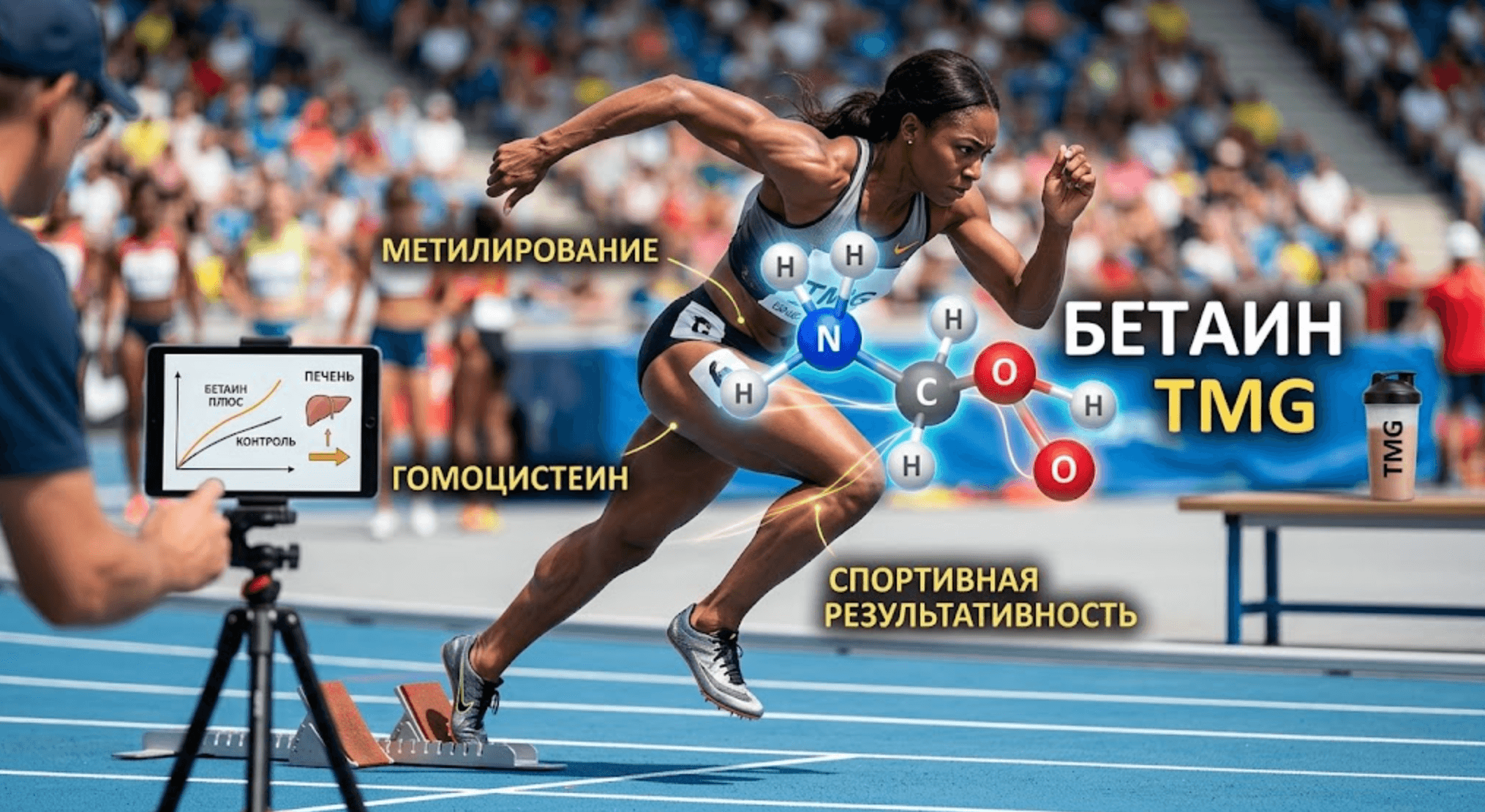
Betaine (TMG): Homocysteine, Methylation, Liver Health, and Exercise Performance
Betaine is a rare example of a compound that sits simultaneously at the center of basic cellular physiology, is used as a prescription drug for severe inherited metabolic disorders, and is sold as an ordinary sports supplement. It is associated with lower homocysteine, support of methylation, liver protection, improved muscle hydration, creatine synthesis, and greater strength. Most of these ideas have a plausible biochemical basis, but the quality of clinical evidence varies substantially.
Chemically, betaine is trimethylglycine, or TMG, a glycine derivative in which the nitrogen atom carries three methyl groups. Under physiological conditions, the molecule exists as a zwitterion: a positively charged quaternary ammonium group and a negatively charged carboxylate group are present within the same molecule. This makes betaine highly water-soluble and allows it to accumulate inside cells at relatively high concentrations without substantially disrupting the function of most proteins and enzymes.
The name does indeed come from sugar beet — Beta vulgaris — from which the compound was first isolated. Biologically, however, betaine is by no means merely a “beet compound.” It is present in plants, animals, and microorganisms, occurs in grains, spinach, quinoa, beets, and seafood, and is also synthesized endogenously in the human body from choline.
Betaine has two fundamental physiological functions. The first is to act as a compatible organic osmolyte, helping cells preserve normal volume and protein structure during osmotic stress. The second is to donate a methyl group to homocysteine in the liver and kidneys, forming methionine. This second role connects betaine with the methionine cycle, S-adenosylmethionine, phosphatidylcholine, creatine synthesis, and epigenetic methylation.
But the fundamental physiological importance of a compound does not mean that taking several grams of supplemental TMG is necessary for everyone. As with NAD, omega-3 fatty acids, and individual vitamins, it is important to separate normal physiology from disease treatment and from attempts to “enhance” a metabolic pathway that is already functioning normally.
Where the Body Gets Betaine
Betaine is obtained directly from food, but it can also be synthesized endogenously from choline. This process is especially active in the liver and kidneys.
Within mitochondria, choline is first oxidized by choline dehydrogenase, CHDH, and the resulting betaine aldehyde is then converted to betaine by aldehyde dehydrogenases, including ALDH7A1. Choline and betaine metabolism are therefore closely interconnected: a molecule of choline may be used to produce phosphatidylcholine and cellular membranes, acetylcholine, or it may be irreversibly directed toward betaine synthesis.
This creates an important metabolic trade-off. Once choline is oxidized to betaine, it cannot be converted back into choline. On the other hand, the resulting betaine becomes a source of methyl groups for homocysteine remethylation. For this reason, choline, folate, vitamin B12, methionine, and betaine cannot be viewed as fully independent nutritional systems — all of them intersect to some extent in one-carbon metabolism.
In some tissues, betaine acts primarily as an osmoprotectant. This has been particularly well studied in the renal medulla, where cells are constantly exposed to high osmolarity. There, the sodium- and chloride-dependent transporter BGT1, or SLC6A12, is expressed and upregulated during hyperosmotic stress under the control of the transcription factor NFAT5/TonEBP. Betaine accumulates inside the cell and helps counterbalance the extracellular osmotic gradient without requiring excessive increases in inorganic ions, which at high concentrations could disrupt protein structure.
This biology gave rise to the popular sports concept of “intracellular hydration.” The physiological premise is real, but the claim that supplemental TMG “pulls water exclusively into muscle cells without ever causing fluid retention elsewhere” goes beyond what human evidence can support. Osmoprotection is a well-established function of betaine. The visual promise of “fuller muscles without subcutaneous water retention” is more marketing than established physiology.
Betaine and Homocysteine: One of Two Routes Back to Methionine
Homocysteine is continuously produced during methionine metabolism. It is not a foreign toxin that must be completely eliminated, but rather a normal intermediate in the methionine cycle. However, marked accumulation — especially in inherited metabolic disorders — can indeed be harmful.
Homocysteine can be converted back to methionine through two major pathways.
The first depends on folate and vitamin B12. The enzyme methionine synthase transfers a methyl group from 5-methyltetrahydrofolate to homocysteine with the help of cobalamin. This pathway is widely distributed throughout the body.
The second pathway uses betaine-homocysteine S-methyltransferase — BHMT. This enzyme is particularly active in the liver and kidneys. It transfers one of betaine’s three methyl groups directly to homocysteine. The result is methionine, while betaine itself is converted into dimethylglycine — DMG.
BHMT truly represents an alternative remethylation route that does not directly require 5-MTHF or vitamin B12 in the reaction itself. This is one reason pharmacological betaine is so important in certain inherited disorders of homocysteine metabolism.
However, the claim that this pathway normally “disposes of up to 50% of all homocysteine” is too categorical. Its contribution depends on tissue, methionine intake, betaine availability, and the activity of other branches of methionine metabolism. Classic work has suggested that BHMT may account for roughly a quarter of hepatic homocysteine metabolism, but this is not a fixed value in every individual.
After donating a methyl group, dimethylglycine does not become useless metabolic waste. In mitochondria, it is progressively converted to sarcosine and then glycine, while one-carbon units can return to the folate pool. Thus, betaine-dependent and folate-dependent methylation are not two fully isolated systems; metabolically, they are interconnected.
Why Methionine and SAMe Matter as Much as Homocysteine
Methionine regenerated from homocysteine can be converted by methionine adenosyltransferase into S-adenosylmethionine — SAMe.
SAMe is one of the body’s major methyl-group donors. Its methyl group is used in a large number of reactions, including DNA and protein methylation, phosphatidylcholine synthesis, neurotransmitter metabolism, and creatine production.
This is why betaine is sometimes marketed as a universal “methylation enhancer.” Biochemically, the idea is not absurd: if BHMT receives more substrate, the flow of homocysteine toward methionine can increase, and levels of methionine and related metabolites may shift.
But methylation is not a scale on which “more is always better.” It is regulated by the concentrations of SAMe and S-adenosylhomocysteine, the activity of dozens of methyltransferases, tissue-specific demand, and the availability of other nutrients. Taking TMG simply to “maximize DNA methylation” without a defined clinical purpose is therefore difficult to justify scientifically.
The same caution applies to popular interpretations of genetic testing. The common MTHFR C677T variant is not equivalent to severe congenital MTHFR deficiency. Having a common polymorphism by itself is not an indication for prescription betaine and does not mean that a person’s folate cycle is “blocked.”
Betaine Really Does Lower Homocysteine
This is one area where the effect is reasonably well established.
In controlled studies of healthy adults, 1.5, 3, and 6 g of betaine per day for six weeks reduced homocysteine by approximately 12%, 15%, and 20%, respectively, compared with placebo. In another study, single doses of 3 and 6 g lowered plasma homocysteine within hours, whereas 1 g did not produce a substantial acute effect.
A meta-analysis of randomized trials also confirmed that betaine supplementation lowers homocysteine. At the same time, the average absolute change in healthy individuals was relatively modest — on the order of 1–1.5 µmol/L.
This supports two different conclusions that should not be confused.
First: betaine is a functional methyl donor and can reduce homocysteine.
Second: lowering homocysteine does not automatically prove a reduction in heart attacks or an increase in life expectancy.
The second point is often lost in supplement marketing.
Is High Homocysteine a Cause of Vascular Disease or a Marker?
With severe inherited homocystinuria, the situation is much clearer. Extremely high homocysteine concentrations are associated with serious vascular, neurological, and other complications, and lowering those levels is part of treatment.
Moderate elevations are more complicated.
Observational studies consistently show an association between higher homocysteine and vascular disease risk. But association does not prove that homocysteine is the sole or direct cause of that risk. Its concentration is influenced by kidney function, folate and B12 status, age, lifestyle, genetics, and other conditions that themselves affect cardiovascular risk.
Large randomized trials of homocysteine lowering with B vitamins have not demonstrated a major reduction in myocardial infarction or overall mortality, although some analyses have shown a small reduction in stroke risk. Moderate hyperhomocysteinemia is therefore better viewed not as an automatically proven “independent toxic trigger of atherosclerosis,” but as a biomarker whose importance depends heavily on clinical context.
There are no large direct trials showing that lowering moderately elevated homocysteine specifically with betaine prevents myocardial infarction.
So when elevated homocysteine is found, the sensible clinical question is first why it is elevated. Vitamin B12 or folate deficiency, impaired kidney function, and an inherited metabolic disorder require very different approaches. Simply lowering the number with TMG is not always the same thing as treating the underlying cause.
Where Betaine Truly Functions as a Drug
Betaine has a much more serious medical history than the sports supplement market might suggest.
Cystadane — prescription anhydrous betaine — is approved for the treatment of homocystinuria, including cystathionine beta-synthase deficiency, severe MTHFR deficiency, and certain disorders of cobalamin metabolism. According to the current U.S. prescribing information, adults and children aged three years and older are generally given 6 g per day — 3 g twice daily. Children younger than three years typically start at 100 mg/kg/day, with dose titration according to homocysteine response.
This context matters. Gram-level doses of betaine have a genuine medical foundation, but that foundation comes primarily from the treatment of rare diseases with extreme abnormalities of homocysteine metabolism, not from a universal wellness protocol.
In CBS deficiency, there is another important limitation. Betaine converts homocysteine into methionine and can therefore further increase an already elevated methionine concentration. The Cystadane label describes cases of severe hypermethioninemia and cerebral edema; in such patients, methionine should be monitored and generally kept below 1,000 µmol/L.
This is a good example of why the statement that betaine is “practically nontoxic” oversimplifies real pharmacology.
The Liver: Why the Theory Is So Compelling
Betaine is especially interesting for the liver because BHMT, the methionine cycle, phosphatidylcholine synthesis, and triglyceride export in VLDL are all highly active there.
Phosphatidylcholine is required for normal assembly and secretion of VLDL particles. One of the pathways that produces it uses the enzyme PEMT — phosphatidylethanolamine N-methyltransferase, which transfers three methyl groups from SAMe to phosphatidylethanolamine.
A shortage of methyl donors can therefore genuinely disturb hepatic lipid metabolism. This is well demonstrated in experimental models of choline and methionine deficiency, in which marked hepatic steatosis develops.
Betaine may potentially support methionine and SAMe availability, influence the SAM/SAH ratio, phosphatidylcholine synthesis, oxidative stress, and several lipid-metabolism pathways. Animal models have reported changes in PPARα, SREBP-1c, mitochondrial function, autophagy, and inflammatory signaling. This is where the concept of betaine as a “hepatoprotective” agent originated.
But human evidence is much less straightforward.
Betaine and Fatty Liver Disease: What Human Studies Show
In an older randomized trial of patients with biopsy-proven NASH, researchers used a very high dose — 20 g of betaine per day for 12 months. The study was small, dropout rates were substantial, and no convincing improvement in overall histological activity or fibrosis compared with placebo was demonstrated. The authors concluded that the striking results seen in animal models were much harder to reproduce in humans.
The story did not end there.
In 2026, new pilot studies were published in people with MASLD — metabolic dysfunction-associated steatotic liver disease. These studies tested substantially lower doses — 1, 2, 4, and 8 g per day for 12–24 weeks. At doses of 2, 4, and 8 g, ALT, AST, and several experimental serum markers of liver injury decreased, whereas 1 g did not show the same effect. About 35% of participants reported mild transient gastrointestinal symptoms.
These are interesting and genuinely more encouraging findings.
But the word “pilot” is crucial. The studies were small, not all groups had full placebo comparisons, and the main outcomes were enzymes and biomarkers rather than demonstrated reductions in fibrosis, cirrhosis, or clinical complications.
So at present, it would be incorrect to say that 2–3 g of TMG is a proven treatment for MASLD or that a course of betaine “restores VLDL export and reverses fatty liver.”
A more accurate conclusion is: the biochemical rationale is strong, recent human data are interesting, but betaine is not yet a standard treatment for MASLD.
An Osmolyte in Muscle: A Real Mechanism, but Not Magical Hydration
The second major area of betaine use is sports performance.
Its osmoprotective function makes the idea biologically plausible. When intracellular osmolarity changes during intense exercise, heat exposure, or dehydration, accumulation of compatible organic osmolytes may help stabilize cell volume and protein structure.
Experimental literature also links changes in cell volume with signaling pathways involved in protein synthesis and breakdown. From this came the hypothesis that betaine might indirectly affect anabolic pathways, including Akt/mTOR.
However, human evidence does not support the claim that 2.5 g of TMG reliably “hydrates myocytes,” switches on mTOR, and suppresses proteolysis to a degree that meaningfully increases muscle mass.
A meta-analysis of body composition outcomes did not find a convincing effect of betaine on body weight, body-fat percentage, fat mass, or fat-free mass.
So it is reasonable to use “cellular hydration” as a physiological mechanism. Presenting it as a proven equivalent of creatine-induced muscle fullness or hypertrophy is not.
What About Creatine Synthesis?
Here there is a genuine biochemical connection.
Endogenous creatine synthesis includes methylation of guanidinoacetate by GAMT — guanidinoacetate methyltransferase. The methyl donor is SAMe. After methyl transfer, S-adenosylhomocysteine is formed and then returned to the methionine cycle.
Creatine synthesis therefore consumes a substantial amount of the body’s methyl metabolism. In theory, betaine could support methionine and SAMe regeneration through BHMT and thereby reduce the methylation burden of endogenous creatine production.
But this does not mean that 2.5 g of TMG increases muscle phosphocreatine in the same way that 3–5 g of creatine monohydrate does.
There is no comparable evidence base for betaine.
Creatine monohydrate directly increases creatine availability to muscle and has an enormous body of clinical and sports research behind it. Betaine affects the pathway indirectly through methyl metabolism. Treating TMG as a “replacement for creatine” is therefore incorrect.
Does Betaine Increase Strength?
The evidence here has become more interesting in recent years.
Early studies were inconsistent. A 2017 systematic review included seven trials, and only two found improvements in strength or power, while the others did not show meaningful effects.
A larger 2024 meta-analysis combined 17 studies and 317 participants. On average, chronic betaine supplementation was associated with a small-to-moderate improvement in maximal strength, with the most consistent effect seen in lower-body performance. There was also a signal for improved vertical jump after exclusion of one low-quality study.
At the same time, the meta-analysis found no significant advantage for upper-body strength, muscular endurance, cycling sprint power, and several other outcomes.
This is much more modest than claims that numerous trials consistently show more repetitions to failure, greater Wingate power, higher growth hormone, lower cortisol, and faster muscle growth.
A more accurate summary is: betaine may provide a small ergogenic benefit for maximal strength, particularly in the lower body, but results are heterogeneous and the evidence base is much weaker than for creatine or caffeine.
Aerobic Endurance and Sprint Performance
The evidence for endurance is even less certain.
A 2025 systematic review found only five eligible studies. Some reported improvements in VO₂, mean or peak power, or lactate-related outcomes, but all included studies were judged to have a high risk of bias. The authors concluded that the available evidence is insufficient to make a confident statement about betaine’s effectiveness for endurance exercise.
So TMG cannot yet be placed in the same category as well-established ergogenic aids.
There is also no basis for attributing universal improvements in “anaerobic bioenergetics” to betaine through presumed enhancement of creatine synthesis.
Where the 2.5-Gram Sports Dose Came From
A dose of 2.5 g per day is indeed very common in sports research and commercial pre-workout formulas. As a result, it has become almost a standard dose in the fitness industry.
But it is better understood as the most common research dose, not as an established physiological requirement.
The 2024 meta-analysis included a variety of dosing schedules and suggested benefits after at least one week of regular supplementation. There is no convincing evidence that betaine must be taken exactly 45 minutes before training or split into 1.25 g before and 1.25 g after exercise.
If an effect exists, it is more likely to arise from chronic changes in tissue pools and metabolism than from an acute stimulant-like effect of a single dose.
So complex TMG timing around workouts is more a convention of the sports supplement market than a proven necessity.
Which Foods Contain the Most Betaine
Despite its name, beets are not necessarily the most concentrated dietary source of betaine.
Particularly rich sources include whole wheat, wheat bran and germ, certain other whole grains, quinoa, spinach, and marine invertebrates. Analyses of cereal foods have shown especially high concentrations in quinoa and certain wheat fractions.
Average dietary intake varies considerably with eating pattern. One estimate of a Western diet found an average intake of about 130 mg per day, while broader observational analyses have suggested roughly 180 mg. Grain and bakery products often emerge as the main sources, although diets high in whole grains, seafood, or particular vegetables can provide substantially more.
For this reason, popular tables assigning one precise number of milligrams per 100 g to spinach, beets, or bran should be treated as approximate. Concentrations vary with cultivar, growing conditions, processing, and analytical method.
TMG and Betaine HCl Are Not Interchangeable
This is one of the most important practical points.
Betaine anhydrous, or TMG, is anhydrous trimethylglycine. This is the form used as a methyl donor, studied in sports nutrition, and used as the active ingredient in prescription Cystadane.
Betaine hydrochloride, or Betaine HCl, is a different compound used to temporarily lower gastric pH. It can genuinely acidify stomach contents.
But the danger of Betaine HCl is often exaggerated.
The claim that 2.5–3 g of Betaine HCl is “equivalent to drinking concentrated hydrochloric acid” and will inevitably cause a severe chemical burn of the esophagus and stomach is incorrect.
In a small study, healthy volunteers with rabeprazole-induced hypochlorhydria took 1,500 mg of Betaine HCl. Mean gastric pH rapidly fell from about 5.2 to 0.6, yet the compound was tolerated without serious problems.
In another study conducted after a meal, researchers examined doses of 1,500, 3,000, and 4,500 mg, and 4,500 mg was required to substantially accelerate return of gastric pH toward baseline.
This does not mean that Betaine HCl can be taken in gram quantities without caution. It can dramatically change gastric acidity and, importantly, alter the solubility and absorption of other medications. For example, it has been specifically studied as a strategy to improve dasatinib absorption when gastric acid is suppressed.
But that is a very different risk from “a capsule is equivalent to a swallow of concentrated acid.”
Is Betaine HCl a Proven Treatment for “Low Stomach Acid”?
Not really.
Research clearly shows that Betaine HCl can temporarily lower gastric pH. But these studies involved very small numbers of volunteers, and hypochlorhydria was often artificially induced using proton pump inhibitors.
Evidence supporting long-term self-treatment with Betaine HCl for nonspecific complaints attributed to “low stomach acid” is much weaker.
Hypochlorhydria should not be diagnosed solely on the basis of post-meal heaviness, belching, or the feeling that food “does not digest well,” and Betaine HCl should not be confused with ordinary TMG.
They are two different nutritional or pharmacological interventions.
What Happens to Cholesterol?
Betaine has an interesting metabolic paradox.
It can lower homocysteine, yet high doses have also increased atherogenic lipids in some studies.
In early controlled trials, 6 g of betaine per day increased LDL by approximately 0.36 mmol/L and slightly raised triglycerides compared with placebo.
A meta-analysis of studies using at least 4 g/day found a modest increase in total cholesterol, although changes in LDL and triglycerides in that particular analysis did not reach statistical significance.
Another meta-analysis of cardiovascular markers found an increase in total cholesterol of roughly 14 mg/dL and LDL of approximately 10 mg/dL, while homocysteine fell by around 1.3 µmol/L.
This is why the statement “betaine lowers vascular risk because it lowers homocysteine” is too one-sided. At the same time, it may unfavorably alter some lipid markers, especially at gram-level doses and in people with metabolic abnormalities.
The mechanism cannot be reduced simply to “improved VLDL export from the liver.” Lipoprotein metabolism is much more complex, and it is not yet possible to determine precisely how much of the lipid effect comes from enhanced hepatic export and how much from other metabolic changes.
Should Everyone Taking TMG Check Lipids After Six Weeks?
Not necessarily.
For someone taking a small dose for a short period and with low cardiovascular risk, there is no universal mandatory laboratory-monitoring protocol.
But if the intake is several grams daily for months, especially in someone with high LDL, elevated ApoB, metabolic syndrome, or familial hypercholesterolemia, checking lipids is reasonable.
In that situation, it is more informative to assess not only total cholesterol but also LDL-C, HDL-C, triglycerides, and, when available, ApoB.
This is particularly relevant because the supplement may be taken with the goal of “improving methylation and vascular health,” while in a particular individual the laboratory trade-off could move in the opposite direction: homocysteine may fall slightly while the number of ApoB-containing particles increases.
How Safe Is TMG Overall?
There is no single dose that can answer this question for every context.
Prescription Cystadane is used at 6 g/day and sometimes higher in patients with severe homocystinuria, but this is treatment under specialist and laboratory supervision. In a registry of patients with inherited homocystinuria, betaine was generally well tolerated and reduced homocysteine by approximately 29%.
Sports trials commonly use around 2.5 g/day for several weeks.
On the other hand, EFSA took a much more conservative position when evaluating betaine as a novel food ingredient. A proposed level of 2.5 g/day was not considered sufficiently supported for unrestricted use in fortified foods. EFSA instead identified an additional intake of up to 6 mg/kg body weight per day — approximately 400–420 mg for a 70-kg adult — as a conservative safe level above normal dietary intake.
At first glance, these numbers appear contradictory, but they refer to different situations.
A safe level for unrestricted food use in the general population is not the same as a therapeutic dose of a prescription drug under medical supervision.
This is why the existence of Cystadane at 6 g/day does not justify the conclusion that every healthy person can safely take 6 g of TMG indefinitely.
Typical Adverse Effects
The most commonly reported adverse effects are gastrointestinal: nausea, abdominal discomfort, diarrhea, and bloating. Prescription betaine is also known to cause a characteristic body or breath odor in some patients, likely related to trimethylamine metabolism.
In the 2026 MASLD pilot studies, around one-third of participants reported mild transient gastrointestinal symptoms.
In severe CBS-deficiency homocystinuria, special attention must be paid to methionine because of the risk of hypermethioninemia and rare cerebral edema. This is not a typical issue in healthy people, but it demonstrates clearly that betaine metabolism is not simply a harmless process of “excreting the excess.”
Is There Such a Thing as “Betaine Deficiency”?
There is no established RDA or comparable mandatory daily requirement for betaine, and no classic dietary TMG-deficiency syndrome has been defined in healthy humans.
This distinguishes it from vitamin B12, folate, iron, or iodine.
The body obtains betaine directly from food and also synthesizes it from choline. Low dietary intake may influence methylation and homocysteine metabolism, but there is no universally accepted diagnostic threshold for “betaine deficiency” that automatically requires supplementation.
Plasma betaine measurements are therefore rarely needed in routine clinical practice.
Practical Meaning for Someone With Elevated Homocysteine
If laboratory testing shows elevated homocysteine, the first step should not necessarily be a bottle of TMG, but an investigation of the cause.
Vitamin B12 and folate status, kidney function, diet, medications, and the clinical context all matter. If B12 deficiency is present, simply lowering homocysteine with betaine does not treat the deficiency itself or prevent its neurological consequences.
For moderate elevation with normal vitamin status, betaine can indeed reduce the value further, especially at doses in the gram range. But evidence that this correction by itself prevents myocardial infarction is insufficient.
Severe inherited homocystinuria is a different situation: here, anhydrous betaine is a true medication with an established therapeutic role, and dosing is determined by diagnosis and laboratory response.
Practical Meaning for Liver Health
For someone with MASLD, TMG should not currently be viewed as a substitute for weight loss, physical activity, diabetes and lipid management, or other clinically indicated treatments.
New data make betaine an interesting investigational metabolic intervention. But the statement “2–3 g per day restores the liver” is still premature.
If it is used experimentally or as a supplement, particularly at gram-level doses, it is sensible to remember two monitoring domains: liver-related markers and the lipid profile. An improvement in ALT accompanied by a rise in ApoB should not automatically be interpreted as an unequivocal metabolic success.
Practical Meaning for Sports
For athletes, the situation is simpler.
Betaine does not belong in the same evidence category as creatine monohydrate. But modern meta-analysis provides some basis for thinking that regular supplementation may produce a small improvement in maximal strength, particularly in lower-body exercises.
The most commonly studied dose is around 2.5 g/day, but there is no strong evidence that half must be taken immediately before training and half afterward.
If a positive effect occurs, it is more likely to reflect chronic metabolic or tissue changes than an acute stimulant effect from a single dose.
For endurance, sprint performance, body composition, muscle growth, and hormonal responses, the evidence is much less consistent. TMG is therefore best viewed as a possible additional sports supplement after more fundamental priorities — nutrition, protein intake, sleep, training design, and, when an ergogenic supplement is desired, better-established options.
What We Actually Know
Betaine is neither a useless wellness powder nor a universal metabolic “hack.” It is a normal human metabolite with two well-established fundamental roles: it acts as an organic osmolyte and as a methyl donor in BHMT-dependent remethylation of homocysteine.
It really does lower homocysteine, and the effect is dose-dependent.
It really is a medication for certain forms of inherited homocystinuria.
It is genuinely connected with methionine, SAMe, phosphatidylcholine, and one-carbon metabolism.
It has plausible and well-studied mechanisms affecting hepatic metabolism, but clinical evidence for treating MASLD remains insufficient despite interesting 2026 data.
In sports, newer evidence suggests a small possible improvement in maximal strength, but does not support universal claims of increased power, endurance, muscle mass, or anabolic hormones.
And finally, gram-level doses are not metabolically neutral. They can lower homocysteine while at the same time raising total cholesterol and LDL in some people. Lowering one attractive biomarker should therefore not automatically be interpreted as improving overall cardiovascular risk.
The central principle can be summarized this way: TMG is a physiologically important methyl donor and osmolyte with a proven pharmacological effect on homocysteine, but its usefulness depends on the specific goal. Treating inherited homocystinuria, correcting moderately elevated homocysteine, experimental use in MASLD, and sports supplementation are four very different situations that should not be judged by the same level of evidence or the same universal dosing protocol.
This material is for educational purposes only and does not replace medical consultation, diagnosis, or individualized treatment.